


A voice journal app lets you speak your entry instead of typing it, turning your words into a written log in seconds. The best ones go a step further: they parse what you say into structured data, sorting a meal, a mood, a habit, or a medication dose onto a timeline you can look back through.
That distinction matters. A plain voice-to-text journal gives you a wall of transcribed paragraphs: useful for reflection, hard to scan for patterns. A voice journal app built for habit and mood tracking keeps the speed of speaking and organizes what you said into something you can review at a glance weeks later.
What to look for in a voice journal app
- On-device transcription. Speech processed on your phone rather than sent to a cloud service is both faster and more private.
- Structured output. Look for an app that turns “had a rough morning, skipped breakfast, feeling foggy” into separate, searchable entries rather than one long paragraph.
- Hands-free triggers. Siri shortcuts, a widget, or an Action Button matter if you want to log while cooking, driving, or mid-task.
- Editable output. Voice transcription isn’t perfect, so you should be able to tweak an entry afterward without retyping the whole thing.
- A timeline view. The value of a voice journal compounds when entries are chronological and easy to scan across days or weeks.
How to build a voice journaling habit
- Pick one or two moments a day to log, right after a meal or at the end of the day, rather than trying to narrate constantly.
- Speak naturally. You don’t need to structure your sentence for the app; say it the way you’d tell a friend.
- Use hands-free triggers (Siri, widgets) for moments when opening an app isn’t practical.
- Review your week as well as individual entries. The pattern shows up over time.
How to do this with Lopie
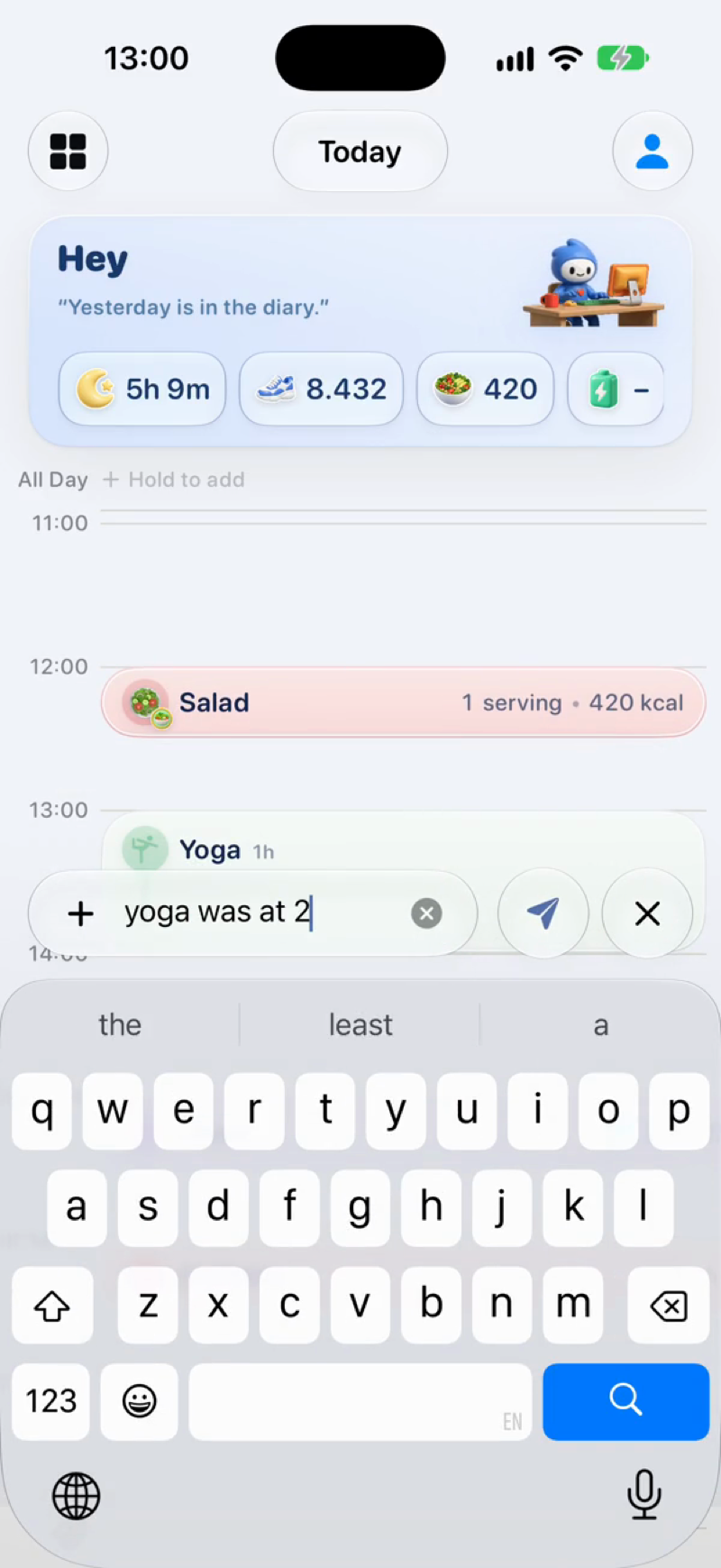
Lopie is a voice journal app built around habits, mood, meals, and routines. Talk to Lopie and it turns your words into a clean, structured log: say “had a big lunch, feeling a bit sluggish” and Lopie separates that into a meal entry and a mood entry, both timestamped on your timeline.
Transcription happens on-device using Apple Speech. Nothing is sent to the cloud to process what you say. Lopie’s natural-language AI search also lets you speak edits: adjust, delete, or resize entries just by talking, no manual dragging required (though you can drag too).
Speak your day, and let Lopie organize it into a timeline you'll use.
Download Lopie for iPhone (free)You’re not limited to opening the app either. Say “Log my day in Lopie” to Siri, use the Action Button, or log from a widget on your Lock Screen. Captures queue durably and parse the next time Lopie’s open. Everything lands on one timeline alongside meals, water, mood, energy, routines, and medication, and Lopie’s AI pattern spotting looks across it all to surface possible connections behind your good and bad days.
Your weekly recap turns a week of voice entries into a short, calm summary: wins, a pattern to watch, and a plan for the days ahead. It’s private by design, and nothing you say is ever used to target ads.
Lopie is free to download, with a 7-day free trial of Lopie+ (then $69.99/year or $2.99/week), which includes the full pattern spotting and recap features.
Is there an app where I can just say what happened instead of filling in forms every day?
Yes. That’s the idea behind Lopie: instead of a daily form with fields to work through, you say one sentence, like “skipped breakfast, walked at lunch, felt flat by four,” and Lopie splits it into a meal, an activity and a mood entry on your timeline. There’s no checklist to open first and nothing to tick. You can type or take a photo instead when talking isn’t convenient, and you can edit any entry afterward if the transcription missed something.